Today, October 12, marks the 27th anniversary of the adoption of the Act "On the State Independence of the Republic of Abkhazia."
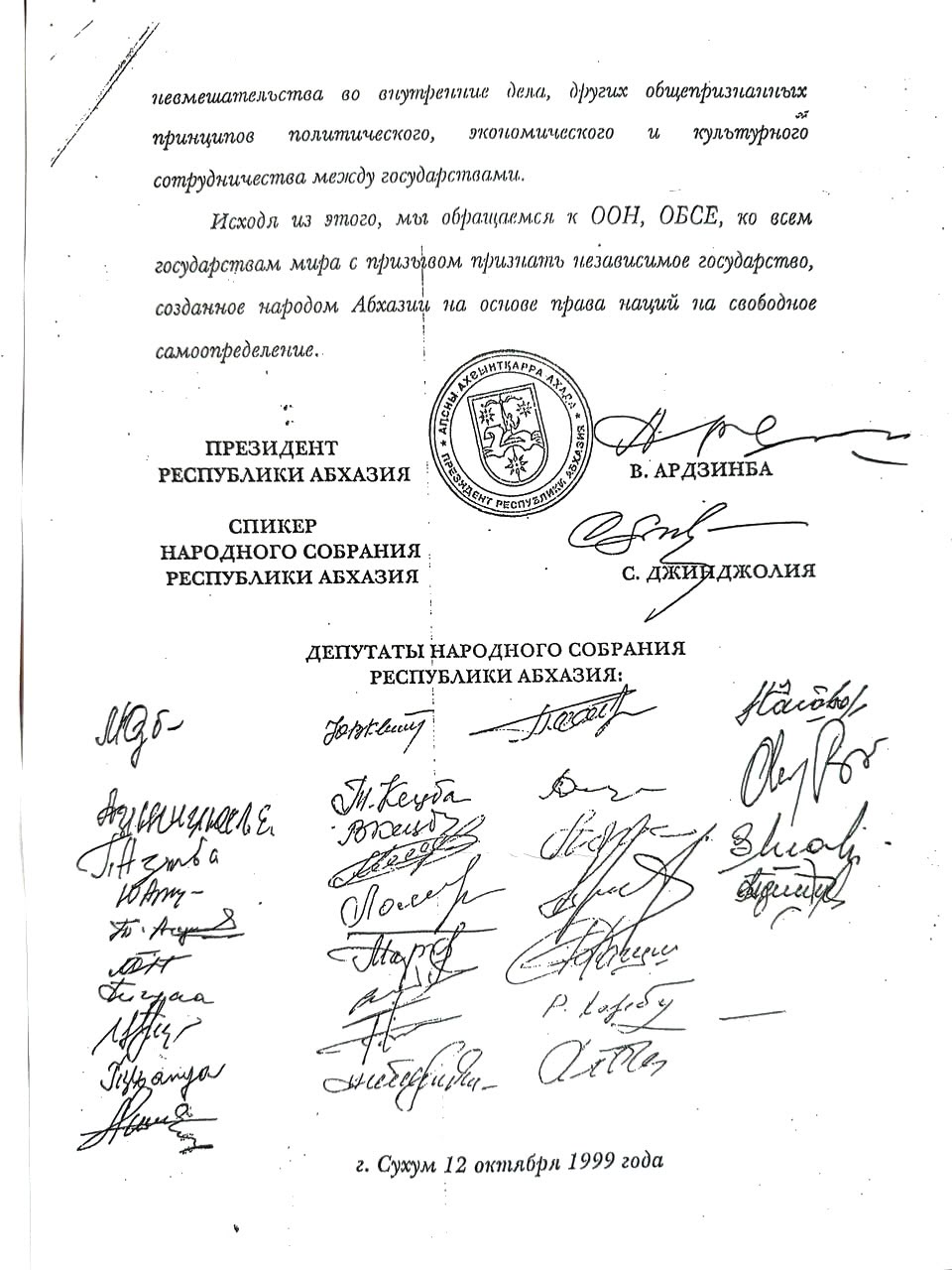
This historic document, adopted by the People's Assembly of the Republic of Abkhazia, became a significant milestone in the history of modern Abkhazian statehood. The Act was signed by the President of the Republic of Abkhazia, Vladislav Ardzinba; the Speaker of the People's Assembly, Sokrat Dzhindzholia; and deputies of the People's Assembly.
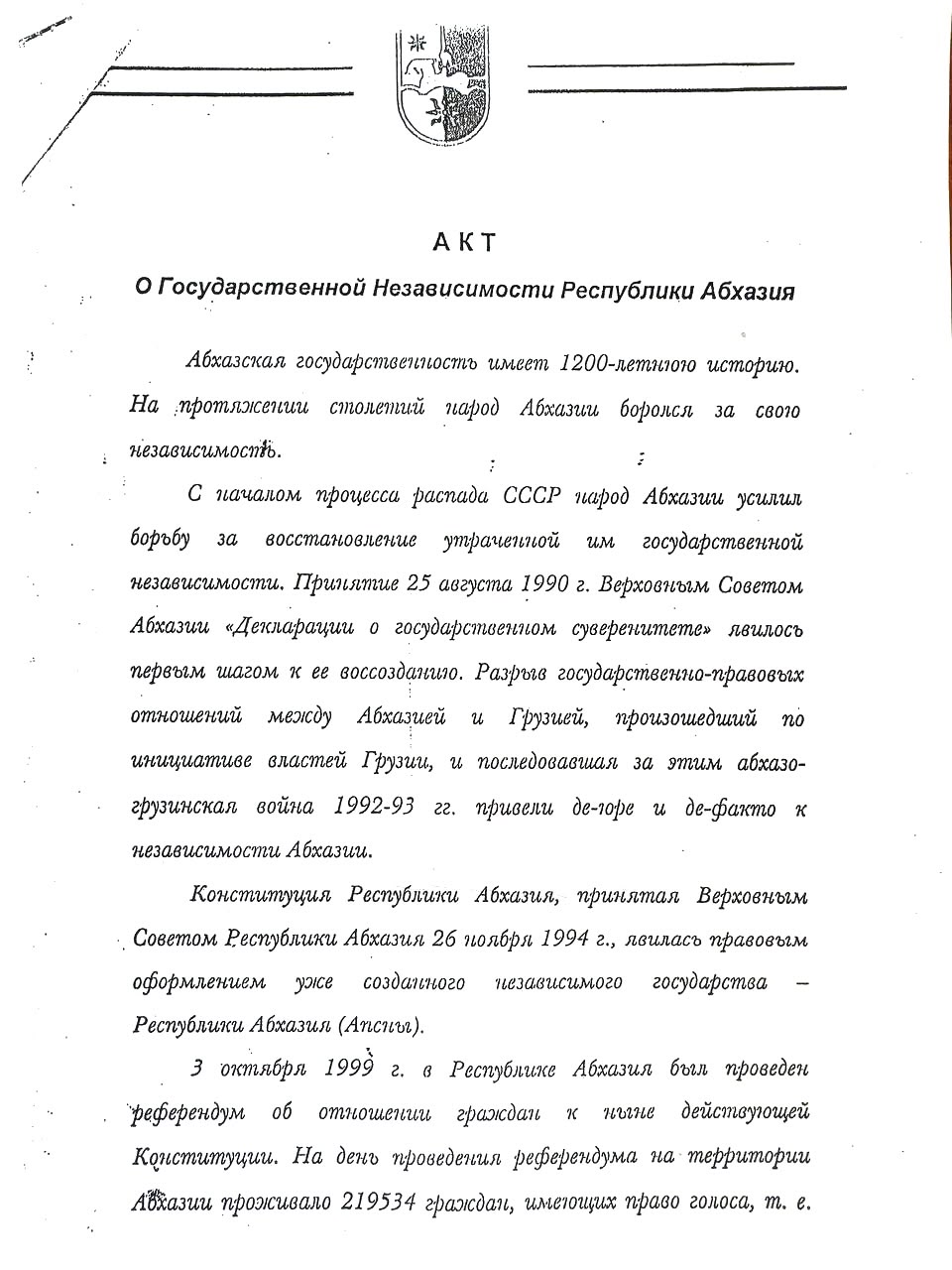
ACT "ON THE STATE INDEPENDENCE OF THE REPUBLIC OF ABKHAZIA"
Abkhazian statehood has a 1,200-year history. For centuries, the people of Abkhazia have struggled for their independence.
With the onset of the dissolution of the USSR, the people of Abkhazia intensified their struggle to restore their lost state independence. The adoption of the "Declaration on State Sovereignty" by the Supreme Council of Abkhazia on August 25, 1990, was the first step toward its re-establishment. The severance of state-legal relations between Abkhazia and Georgia—initiated by the Georgian authorities—and the subsequent Abkhazian-Georgian war of 1992–1993 led to Abkhazia's independence, both *de jure* and *de facto*. The Constitution of the Republic of Abkhazia, adopted by the Supreme Council of the Republic of Abkhazia on November 26, 1994, served as the legal formalization of the already established independent state—the Republic of Abkhazia (Apsny).
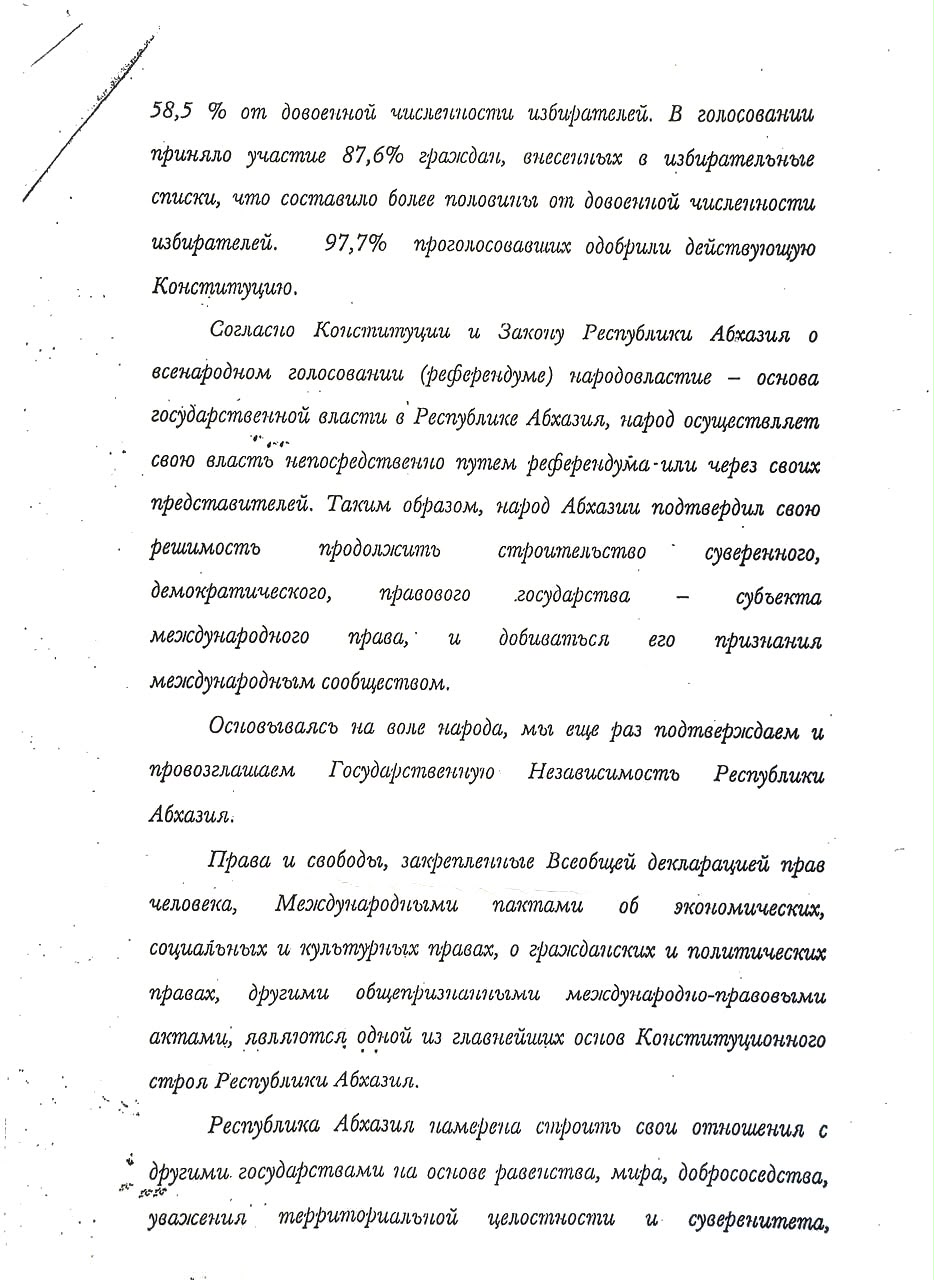
On October 3, 1999, a referendum was held in the Republic of Abkhazia regarding the citizens' stance on the current Constitution. At the time of the referendum, 219,534 eligible voters resided in Abkhazia, representing 58.5% of the pre-war electorate. Voter turnout was 87.6% of those on the electoral rolls, amounting to more than half of the pre-war electorate. 97.7% of those who voted approved the current Constitution.
In accordance with the Constitution and the Law of the Republic of Abkhazia on Popular Voting (Referendum), the sovereignty of the people forms the basis of state power in the Republic of Abkhazia; the people exercise their power directly through referendums or through their representatives. Thus, the people of Abkhazia reaffirmed their determination to continue building a sovereign, democratic state governed by the rule of law—a subject of international law—and to seek its recognition by the international community.
Based on the will of the people, we once again reaffirm and proclaim the State Independence of the Republic of Abkhazia.
The rights and freedoms enshrined in the Universal Declaration of Human Rights, the International Covenants on Economic, Social and Cultural Rights and on Civil and Political Rights, and other generally recognized international legal acts constitute one of the fundamental pillars of the constitutional order of the Republic of Abkhazia. The Republic of Abkhazia intends to build its relations with other states on the basis of equality, peace, good-neighborliness, respect for territorial integrity and sovereignty, non-interference in internal affairs, and other universally recognized principles of political, economic, and cultural cooperation between states.
Accordingly, we call upon the UN, the OSCE, and all states of the world to recognize the independent state established by the people of Abkhazia based on the right of nations to free self-determination.
President of the Republic of Abkhazia V. Ardzinba
Speaker of the People's Assembly of the Republic of Abkhazia S. Dzhindzholia
Deputies of the People's Assembly of the Republic of Abkhazia
Sukhum, October 12, 1999